
By partnering with over 6,000 influencers a year, this brand sells niche products on TikTok and generates millions in monthly revenue.
As the 3D printing market becomes increasingly crowded, numerous brands have flocked to the all-in-one printer market, getting caught up in a red ocean of intense competition marked by specs wars and price wars. Profits are being squeezed, and the competition has long since reached a fever pitch.
While everyone else is busy competing over printer hardware, one Chinese brand has broken free from conventional thinking. Instead of jumping on the bandwagon and joining the all-out battle for the complete printer market, it has charted its own course, focusing on the often-overlooked 3D printing filament sector. With its unique strategic vision, it has firmly established itself in the global market.
That brand is SUNLU. As of now, Noxinfluencer’s TT Shop data shows that its total sales have reached over 200,000 units, with revenue hitting $6.3159 million. And that doesn’t even include revenue from Amazon and its independent website—it’s no exaggeration to say they’ve made a killing.(We cordially invite you to try it out:Influencer Marketing Platform & Analytics Tool | NoxInfluencer)

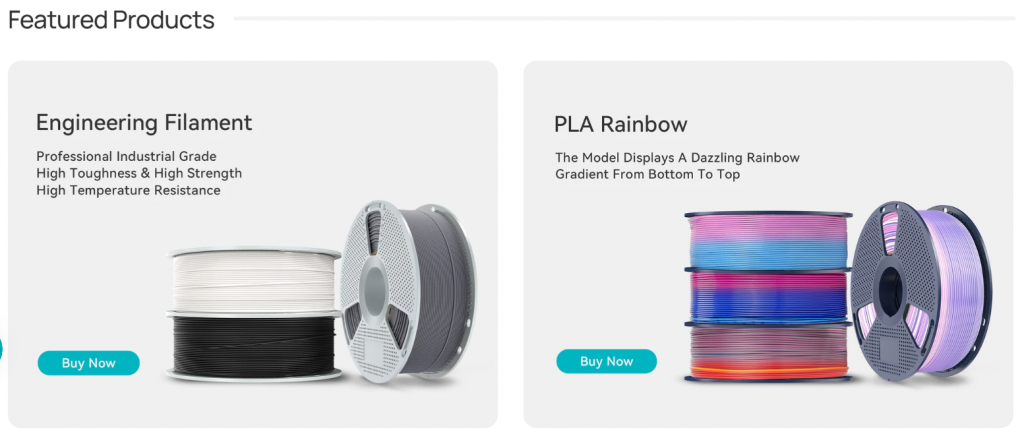
I. Cutting-Edge Product Capabilities: Capturing the Hearts of Overseas Users Through Technology and Attention to Detail
In the 3D printing filament industry, users commonly complain about these issues: inconsistent filament diameter causing frequent nozzle clogs, and tangled or knotted filament leading to print interruptions… These problems not only diminish the printing experience but also represent a major hurdle that countless brands struggle to overcome. SUNLU’s product advantages, however, precisely address these “industry-wide pain points”:
Unparalleled Precision and Craftsmanship: The core PLA filament maintains a diameter tolerance of ±0.02mm, eliminating nozzle clogs and layer streaks; our proprietary neat winding mechanism completely resolves filament tangling, improving print smoothness by over 40%.
Environmental Sustainability and Regulatory Compliance: Our PLA filament is made from renewable plant sources such as corn and sugarcane, making it biodegradable and aligned with environmental policies and consumer preferences in Europe and the U.S. It has obtained international certifications including RoHS, REACH, FCC, and CE, clearing all barriers to global market access.
Comprehensive Product Range and Customization: We offer over 20 types of filaments—including PLA, ABS, PETG, PCL, carbon fiber, glow-in-the-dark, and thermochromic—in more than 30 colors, covering basic, engineering, and creative applications. We simultaneously expand our lineup of peripherals, such as drying ovens, printing pens, and photopolymer resins, to create a “filament + tools” ecosystem.
II. Globalization of the Supply Chain: Strengthening Delivery and Cost Advantages
3D printing filaments are inherently a low-margin, high-turnover product category, with raw materials, production, and logistics accounting for the bulk of PLA filament costs. Meanwhile, European and American customers placing orders on Amazon or TikTok have low tolerance for delivery delays; many consider “receiving goods within 3–7 days” to be the standard experience.
SUNLU has built a resilient supply chain through a “dual domestic production base + overseas capacity + global warehouse network” model, solving the three major challenges of cross-border e-commerce: “delivery time, cost, and inventory.”
Scaling domestic production capacity: The East China base in Anhui began operations in 2018, followed by the South China base in Guangdong in 2022, creating a north-south synergy; with a total monthly production capacity exceeding 1,500 tons and over 150 production lines, we support global order fulfillment.
Localized overseas production: The Vietnam facility began operations in August 2024, reducing tariffs and logistics costs while mitigating trade risks; the German subsidiary launched in November 2024, enabling local R&D, sales, and after-sales service in Europe, with response times improved by over 60%.
Efficient Global Warehouse Network: We have established overseas warehouses in the U.S., Germany, the U.K., and other regions, utilizing a combination of Amazon FBA and third-party warehouses; shipping and insurance costs as a percentage of export revenue remain stable at 25.58%–26.89%, while delivery times have been reduced from 30 days to 3–7 days, significantly enhancing the user experience.
The greatest concern for brands expanding overseas is external uncertainty—changes in tariff policies, raw material shortages, and rising international logistics costs. The more concentrated the supply chain, the more vulnerable it is to collapse. Through a strategy of “dual domestic bases + an overseas factory in Vietnam + local operations in Germany,” SUNLU has diversified its supply chain. This ensures that even if a single link in the chain fails, the entire system will not collapse.
III. Influencer Marketing: Igniting Social Media
Consumable products are naturally ideal candidates for influencer marketing. This is because they are items that users will continue to purchase once they’ve bought them for the first time. Brands only need to attract users through a single successful influencer campaign; thereafter, they can continue to generate revenue through word-of-mouth and repeat purchases.
SUNLU is a benchmark for influencer marketing in the 3D printing consumables sector. According to data from the Noxinfluencer platform, the company collaborated with as many as 6,195 influencers within a single year, resulting in 26,800 influencer videos, with the majority of these collaborations taking place on TikTok.(We cordially invite you to try it out:Influencer Marketing Platform & Analytics Tool | NoxInfluencer)
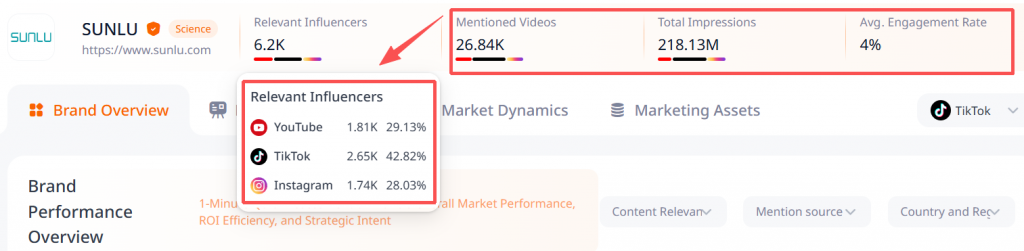
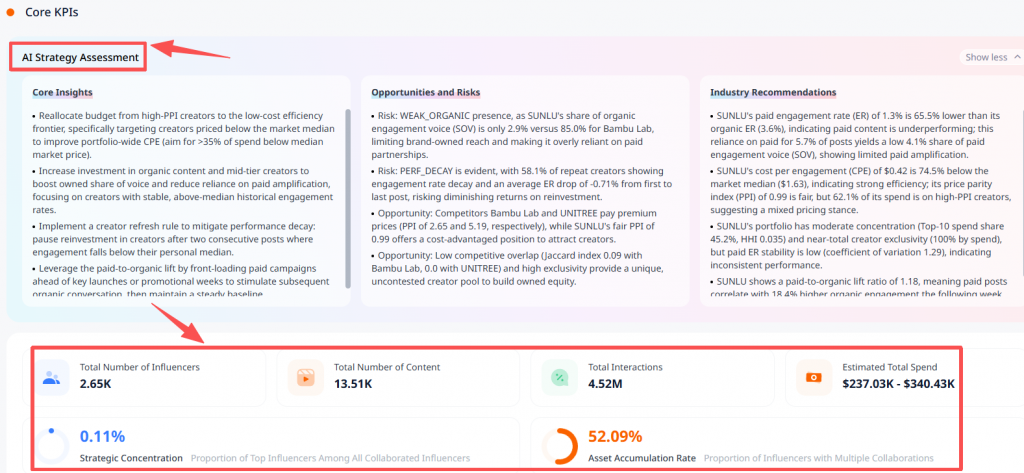
In addition, Noxinfluencer’s AI strategic assessment tool reveals that its overseas influencer marketing strategy centers on “low cost, avoiding top-tier influencers, and broad coverage.” By adopting a volume-driven approach focused on mid-tier and long-tail influencers—who account for just 0.11% of the market—the company avoids the premium associated with top-tier influencers and minimizes overlap with competitors (with only a 9% overlap rate with Bambu Lab). This approach achieves a cost advantage with a low cost per engagement of 0.419 (significantly below the market median), and paid investments effectively drive organic traffic.
SUNLU’s collaborations with influencers follow a typical “pyramid structure,” with micro-influencers and small-scale influencers forming the core, supplemented by mid-tier influencers. These collaborations are highly concentrated in the technology niche, while general categories such as DIY and entertainment account for less than 10% of the total.
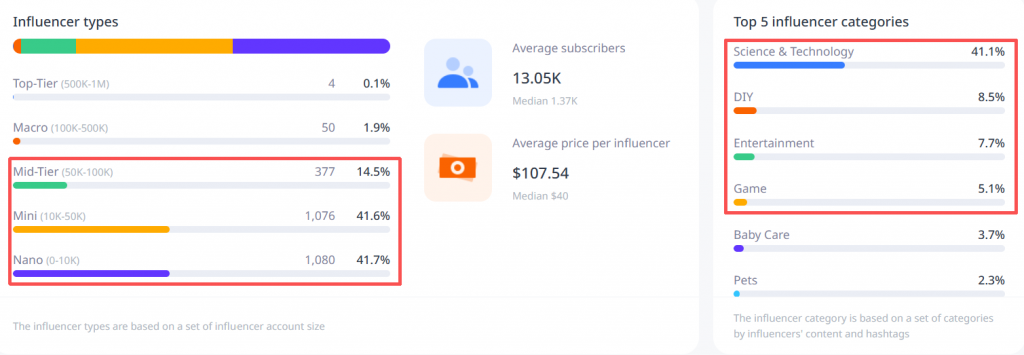
This strategy aligns with the characteristics of the 3D printing consumables category—low average order value, high repurchase rates, and strong word-of-mouth—allowing the company to avoid the high premiums associated with top-tier influencers while leveraging the professional endorsements of tech-focused influencers to precisely target the core user base of 3D printing.(We cordially invite you to try it out:Influencer Marketing Platform & Analytics Tool | NoxInfluencer)
With its “small consumables, big market” strategy, SUNLU has established itself as a benchmark for Chinese brands in the global 3D printing consumables sector.
Looking ahead, as the consumer-grade 3D printing market continues to expand, SUNLU is poised to further solidify its position as a global leader by leveraging its technological, supply chain, and marketing strengths, thereby providing a replicable “consumables model” for Chinese manufacturers looking to expand overseas.
