
With over 7,000 influencers in a single year, this drone brand is taking the market by storm.
Have you ever imagined that the world could be revealed from a different perspective? With a drone in hand, mountains, rivers, and oceans are no longer out of reach. From the peaks of snow-capped mountains to the depths of canyons, the vastness of the sky and earth unfolds before your eyes, and the whole world seems to shrink.
Yet in the consumer drone market, DJI has long established an unshakable industry barrier. In this seemingly saturated “red ocean” where the landscape appears set in stone, an emerging brand—HOVERAir—has carved out its own niche through a fresh product philosophy and global expansion strategy.
Backed by impressive market performance, the brand has secured strategic investment from Anker Innovation, charting a unique path to global growth.
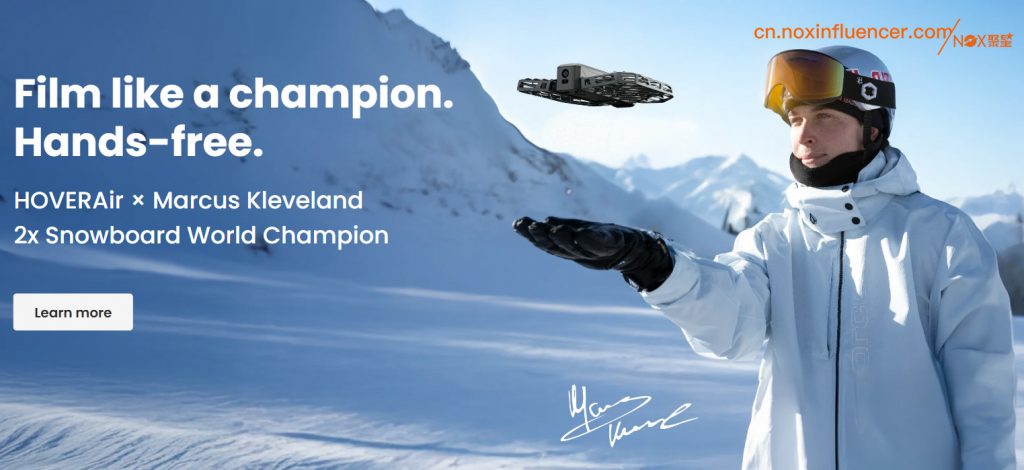
I. The Founder’s DNA: Commercializing Technological Idealism
HOVERAir’s success stems primarily from its founder Wang Mengqiu’s unique technical background and market insight.
Born in Hangzhou in 1982, Wang Mengqiu earned his bachelor’s degree from Beihang University before pursuing a master’s degree in computer science at Carnegie Mellon University and a Ph.D. in artificial intelligence at Stanford University. During his Ph.D. studies, he received the AAAI Outstanding Paper Award and the Best Engineering Award from the Association for the Advancement of Artificial Intelligence (AAAI). After graduation, he became an early employee at Twitter, where he developed the recommendation engine that formed the core of Twitter’s operations at the time.
In 2014, Wang Mengqiu gave up his high salary and equity incentives in Silicon Valley to return to China and found Zero Zero Technology (HOVERAir’s parent company).
“A person’s life begins at zero and ends back at zero. But when two zeros are placed together, they form infinity (∞), and between those two zeros lies infinite possibility.” “This is Wang Mengqiu’s interpretation of the company name ”Zero Zero Technology.”
His entrepreneurial vision stemmed from a simple yet profound insight: most consumers use drones not for professional aerial photography, but to document their lives, and the complex operation of traditional drones excludes a vast number of potential users.
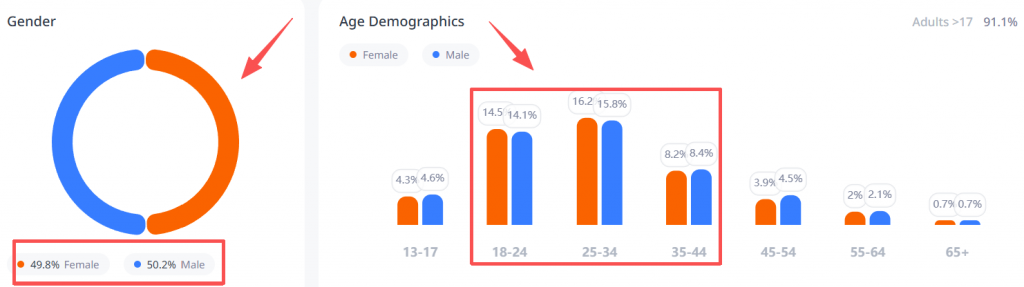
According to data from the Noxinfluencer‘s platform(AI YouTube Analytics & Leading Influencer Marketing Platform – NoxInfluencer), HOVERAir’s core target audience consists of young adults who have their own spending power, love travel and outdoor activities, enjoy sharing on social media, and seek a sense of ritual in their daily lives.
II. Product Strategy: Subtraction Over Addition
(1) Redefining the Category: From Drones to Flying Cameras
HOVERAir’s core strategy is to avoid direct competition with DJI in the professional aerial photography sector, instead repositioning its products as “lifestyle recording tools” and “flying photographers.”
Traditional drones emphasize “flying farther and capturing clearer footage,” but HOVERAir discovered that 90% of users’ aerial photography needs can be met within a range of 500 meters to 1 kilometer, making the pursuit of extreme flight distances or altitudes unnecessary. Based on this insight, HOVERAir has focused its products on three core strengths: smaller, lighter, and smarter.
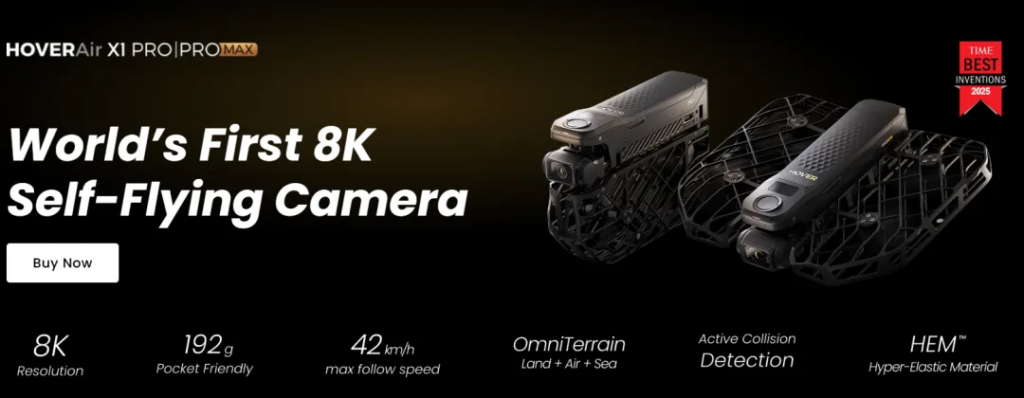
Take the X1 series as an example: the entire unit weighs just 125 grams (the X1 Smart weighs as little as 99 grams). It supports foldable storage, remote-controller-free operation, and AI-powered automatic camera movements, delivering a “plug-and-play experience, palm-sized takeoff and landing, automatic tracking, and one-click photo capture.”
III. Crowdfunding Strategy: Low-Cost Validation and Seed User Acquisition
HOVERAir’s journey toward global expansion began on crowdfunding platforms. This strategy not only addressed the new brand’s initial funding needs but, more importantly, enabled low-cost validation of market demand and the targeted acquisition of seed users.
In 2022, HOVERAir expanded globally through crowdfunding platforms. Its HOVERAir X1 launched on Indiegogo, raising $1.8 million within a few months and becoming the world’s second-largest crowdfunding campaign that year.
In 2024, the X1 Pro and Pro Max returned to Indiegogo, surpassing $2.1 million on the first day alone. Within a month and a half, they raised over $4.7 million, setting the platform’s annual crowdfunding record and garnering support from nearly 6,500 consumers.
The company’s localization strategy was evident even during the crowdfunding phase. In response to Japan’s strict regulations requiring prior registration for drones weighing over 100 grams, HOVERAir rapidly developed the X1 Smart model, weighing just 99 grams—just under the regulatory threshold—allowing users to “power on and fly” without registration.
This precisely tailored product was a huge hit on the Japanese crowdfunding platform Makuake, raising 212 million yen (approximately $1.41 million) and setting a new record for the platform’s camera category.
IV. Localized Marketing: From Going Global to Adapting to Local Customs
HOVERAir’s success overseas is largely attributable to its in-depth localization marketing strategy, with targeted influencer marketing and context-driven content serving as its core drivers.
In terms of influencer marketing, HOVERAir has moved away from the traditional approach of “seeking out major accounts and posting sponsored content,” opting instead to collaborate closely with highly relevant professional outdoor-focused KOLs to co-create content, thereby making its marketing more targeted and persuasive.
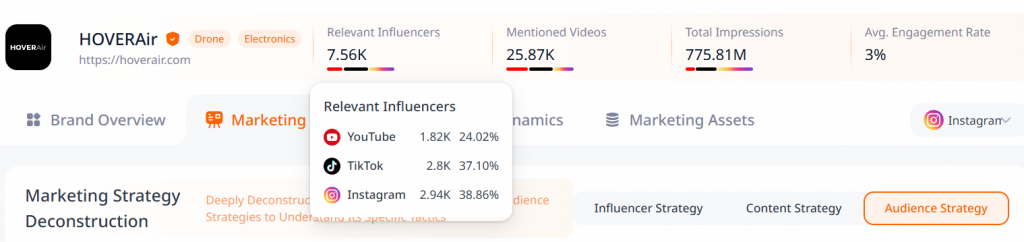
According to data from the Noxinfluencer’s platform(AI YouTube Analytics & Leading Influencer Marketing Platform – NoxInfluencer), HOVERAir has partnered with over 7,500 influencers in the past year and has established a presence on all three major platforms.
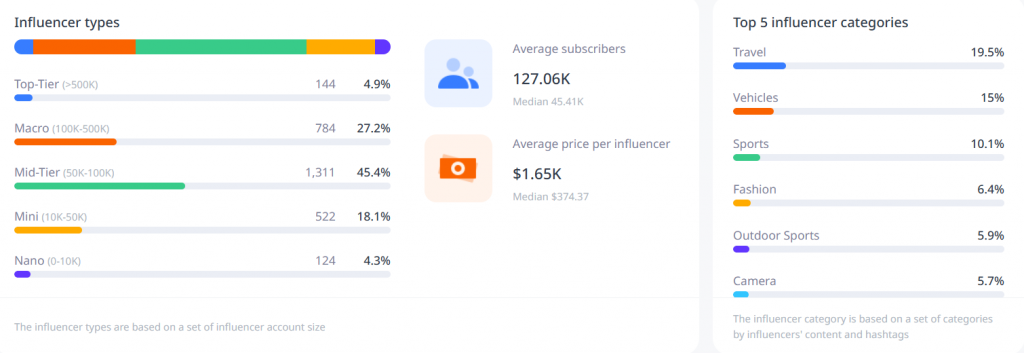
Among influencers, mid-tier influencers clearly dominate, and their content is highly concentrated in three key categories: travel, transportation, and sports.
This is because the core selling points of HOVERAir’s flying camera are outdoor adventures, travel documentation, sports tracking, and on-the-go filming during road trips:
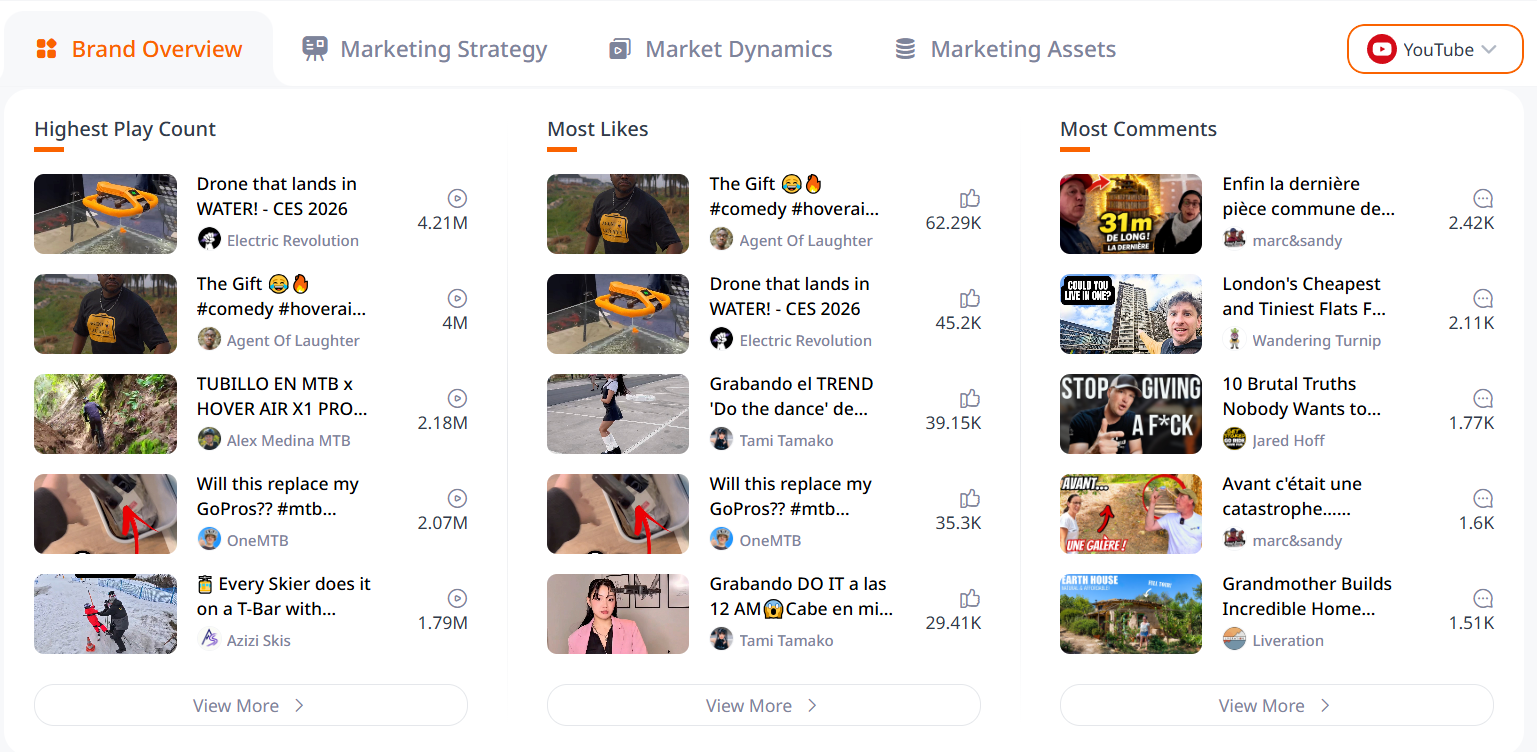
Travel-focused influencers specialize in showcasing stunning aerial footage and vlogs captured on the go; transportation/automotive influencers are well-suited for capturing scenes while driving or cycling; and sports influencers leverage the core features of smart tracking for skiing, cycling, and extreme sports. Collaborating with these influencers allows for precise alignment with the product’s strongest use cases, directly reaching the target audience with extremely high campaign accuracy. This makes it easier for users to intuitively perceive the product’s value and stimulates their desire to purchase.
At the same time, HOVERAir has adopted differentiated scenario-based marketing strategies tailored to the cultural characteristics of different markets. In the European and American markets, the company focuses on the locally popular sports of cycling and skiing—it’s worth noting that there are 500 million cycling enthusiasts worldwide, and 130 million skiers, with over 60% concentrated in Europe and the U.S. To this end, HOVERAir has also formed a strategic partnership with the U.S. Ski Association, becoming the official designated filming equipment. Through a wealth of GIFs and short videos, it vividly demonstrates the product’s portability and smart filming advantages in cycling and skiing scenarios, delivering a direct and impactful promotional effect.
In the Japanese market, the brand emphasizes family-oriented recording scenarios, precisely aligning with Japanese consumers’ desire to capture heartwarming moments such as family gatherings.
By 2026, HOVERAir had expanded into more than 30 countries and regions worldwide, becoming a model for Chinese tech brands that go global with a “small yet exquisite, specialized yet refined” approach.
Its success story demonstrates that even in markets dominated by industry giants, it is possible to break through overseas by accurately identifying user needs, committing to product innovation, and focusing on localized operations.
