
Topping the charts in North America and a bestseller in over 100 countries! This backpack from China is flying off the shelves.
When it comes to carry-on bags, countless Chinese sellers are mired in a vicious cycle of price wars, and breaking into the European and American markets with an ordinary chest pack or waist pack is as difficult as climbing a mountain.
But WATERFLY, a brand born in Shenzhen, China, has delivered a completely different outcome: topping the charts in North America and selling well in over 100 countries, it has firmly established itself in the light outdoor gear segment with nothing but lightweight, compact sports bags. As of 2026, WATERFLY products have been sold in over 100 countries worldwide, serving a cumulative total of more than 30 million consumers.
How has a seemingly ordinary backpack managed to break free from the shackles of price wars and win the favor of tens of millions of consumers globally? Today, the Noxinfluencer editorial team will take a closer look with you!
I. Build the Brand First, Then the Product
WATERFLY’s breakthrough began with a revolution in thinking.
Founder Adam initially adhered to a “make money fast” approach focused on mass production, but during the transition to a curated model from 2017 to 2021, he discovered that relying solely on Amazon had very limited growth potential—according to Statista data, Amazon accounted for only 13% of the global retail market in 2021, and even in its home market of the United States, it accounted for just 37.8%.
This meant that “selling on Amazon” was far from synonymous with “building a brand”; a true brand must transcend platforms, regions, and cultures. Consequently, the founder proposed nurturing the brand as if it were a complete human being: the product is the body, quality is physical health, the name is identity, culture is the mind, and operations are behavior. This philosophy drove WATERFLY to shift its focus from products to value.
Building on this foundation, the brand was imbued with a unique spiritual core—“Enjoy your life.” This slogan stems from the founder’s solitary childhood memories spent in nature and incorporates the Eastern philosophy from the *Tao Te Ching*: “Water benefits all things without competing.” Through the imagery of water and a butterfly (Water + Butterfly), it conveys a life philosophy characterized by tranquility, lightness, and self-transformation.

It is precisely this approach—first establishing brand awareness and then infusing the brand with a cultural soul—that has enabled WATERFLY to forge an emotional connection and a sense of identity in the market that transcends the physical product, laying the fundamental groundwork for the brand to become a global benchmark in its niche category.
II. Differentiated Market Positioning to Capture the Blue Ocean in the Light Fitness Segment
The most fatal mistake in market competition is going head-to-head with leading international brands.
Traditional outdoor giants like The North Face and Arc’teryx focus on large hiking backpacks and professional mountaineering gear, while a large number of unbranded sellers crowd the generic, budget-friendly luggage market, where products have similar features and competition is driven by a race to the bottom on prices. WATERFLY made a highly forward-thinking strategic choice: it abandoned the mass-market, high-capacity backpack segment and instead focused on lightweight, compact sports bags, targeting “light-activity scenarios” such as urban commuting, short hikes, jogging, cycling, and everyday travel.
The brand identified a clear trend in the European and American consumer markets: in the post-pandemic era, mainstream outdoor activities have shifted from high-intensity, professional hiking to low-threshold, everyday light outdoor pursuits. Consumers no longer seek only extreme outdoor gear; they need a compact bag that balances athletic functionality, everyday style, and portability.
Based on this insight, WATERFLY established a clear user profile: young and middle-aged urbanites in Europe and the U.S., short-distance travelers, and urban joggers. The products are designed to address the core needs of “storing small personal items, comfortable carrying, and versatility across multiple scenarios.”
The brand philosophy incorporates the Eastern concept of “The highest good is like water.” Distinguishing itself from the hardcore adventure narratives of Western outdoor brands, it cultivates a gentle, lifestyle-oriented image for light travel, establishing a unique brand identity in consumers’ minds.
III. Establishing a Strong Presence on Platforms, Expanding Reach Beyond Social Media, and Achieving Omnichannel Penetration Across Online and Offline Channels
WATERFLY employs a four-tier channel strategy—“using Amazon as the foundation, leveraging influencer marketing to amplify reach, building a private customer base through its independent website, and achieving brand elevation via offline channels”—to gradually transition from a platform seller to a global brand.
(1) Refined operations on Amazon to establish a benchmark brand in the category.
In the early stages of the brand’s global expansion, Amazon North America served as the core market, with the FBA logistics system ensuring a seamless fulfillment experience. The operations team focused on optimizing search keyword strategies and localizing product listing copy, while continuously managing customer reviews to maintain a positive reputation. By relying on high-quality products that naturally garnered positive reviews, the brand secured stable search rankings.
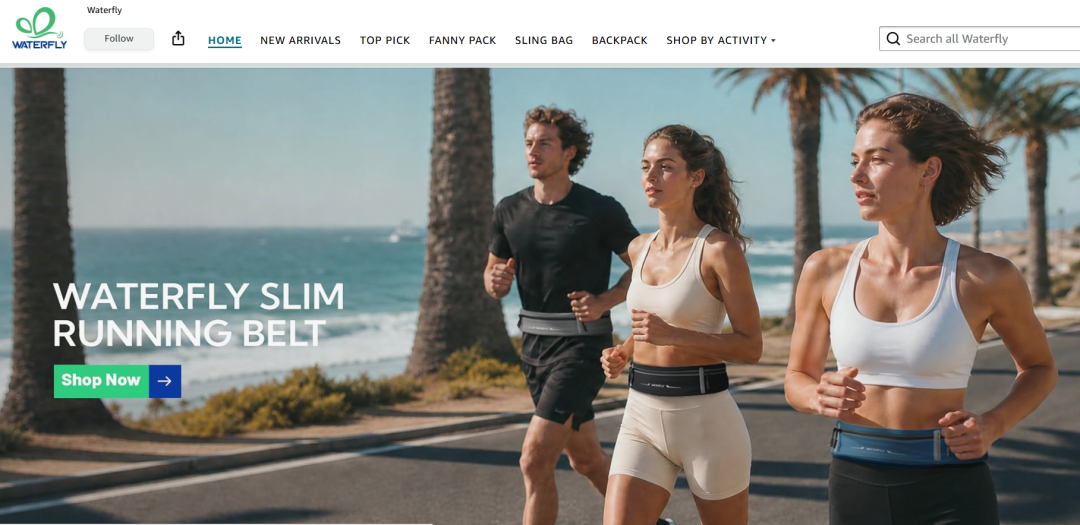
Unlike sellers who focus on mass distribution and frequently change their SKUs, WATERFLY continuously refines its core best-selling products. By relying on a solid reputation, it has maintained a long-term presence on niche bestseller lists, creating a virtuous cycle. After establishing a firm foothold in the U.S. market, the company has gradually expanded into Amazon’s European and Japanese marketplaces.
(2) Scaling Up the Influencer Network and Product Testing
Against the backdrop of rising Amazon search traffic costs, WATERFLY has partnered with a large number of influencers.
Most of its influencer marketing videos focus on the product’s hardware features and common pain points during use. The content is precisely tailored to the needs of the target audience. For urban hikers, joggers, cyclists, and day-trippers, the top priorities are a secure fit, theft protection, and portable storage.
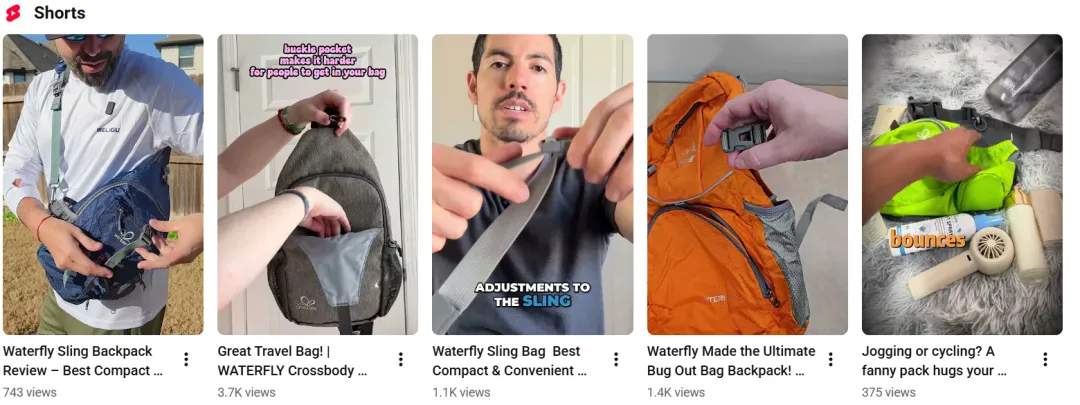
Focus entirely on real-life scenarios such as light outdoor activities and daily commutes—no hollow brand promotional videos.
(3) Independent Website + Multi-Platform Expansion.
The brand simultaneously launched its official multilingual independent website, waterflyshop.com, to build a loyal customer base and break free from the constraints of a single platform’s rules;
In addition, the brand has expanded to over 30 major global e-commerce platforms, including AliExpress, TikTok Shop, Lazada, and SHEIN, covering diverse markets in North America, Europe, and Southeast Asia. The standalone website serves not only as a sales channel but also as a central showcase for the brand’s story and product philosophy, thereby strengthening brand awareness.
(4) Moving Beyond Online: Expanding into Formal Offline Channels to Establish Brand Credibility.
After stabilizing online sales, WATERFLY launched the development of offline channels by establishing a global network of distributors. A landmark achievement was the successful entry into Decathlon’s European online channels.
Gaining access to the world’s leading sports retail channels signifies that the brand’s product quality, compliance standards, and brand identity have been recognized by international professional retailers, setting it apart from generic online sellers. Through its global distributors, the brand has also entered regional outdoor specialty stores, creating a closed-loop ecosystem where customers discover products online and experience them in-store.
From a small company in Bao’an, Shenzhen, to being voted “Best Waist Bag” by U.S. consumers, WATERFLY has spent a decade proving that when a product has a soul, a brand has a spirit, and operations have a global perspective, even a “run-of-the-mill” waist bag can take flight around the world.
Looking ahead, as global demand for light outdoor gear and urban mobility continues to grow, WATERFLY—which remains committed to lightweight travel gear—is poised to further expand its lead in this niche market and become a benchmark for the globalization of Chinese sports equipment brands.
